
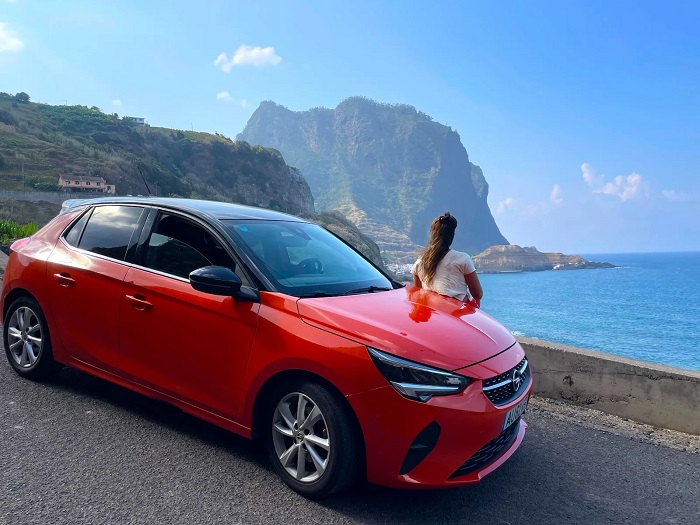
An automatic car is not mandatory in Madeira, but for many visitors it is the more comfortable choice. The island’s expressways are modern, the tunnels remove many difficult coastal sections and the main tourist routes are paved. The challenge usually begins after leaving those roads, when the final approach to a hotel, viewpoint or village involves a steep climb, a tight bend or a narrow street with limited space to stop.
The better question is not simply automatic or manual. It is whether the driver can manage hill starts, controlled descents and frequent gear changes while navigating an unfamiliar island. In 2026, Madeira continues to be an excellent destination for independent travel, but the right transmission can make a noticeable difference to the experience.
What Driving in Madeira Is Actually Like
The journey from Madeira Airport to Funchal takes approximately 20 to 25 minutes and follows a straightforward road network. Drivers encounter tunnels, roundabouts and elevation changes, but either transmission is suitable. The route may become more demanding during the final few kilometres if the accommodation is above central Funchal, in Monte, São Roque or another hillside area.
Roads in older neighbourhoods can be steep and narrow, with parked vehicles reducing the available space. A manual car requires confident clutch control when moving from a standstill on an incline. An automatic removes that task, allowing the driver to concentrate on positioning and approaching traffic.
Madeira’s official tourism guidance also advises drivers not to trust every shortcut suggested by navigation applications. A route that appears faster may lead to an impractically steep residential road. Staying on main signed roads is usually easier, even when the distance is slightly longer.
On a narrow sloping road where only one vehicle can pass, the vehicle travelling downhill has priority. Drivers should slow down early and use a wider section of the road to make space. A short horn signal may also be used before a blind bend to warn approaching traffic.
Where an Automatic Car Makes the Biggest Difference
Funchal itself does not require an automatic, but one is helpful when driving between the waterfront and higher districts. Traffic, junctions and repeated hill starts can make a manual car tiring, particularly for someone who does not drive one regularly.
The road towards Monte involves a sustained climb from the city. Routes to Curral das Freiras, Santana and the central mountains include bends and significant changes in elevation. An automatic reduces the number of gear changes, but the driver must still select an appropriate low or manual mode on long descents.
Pico do Areeiro stands at 1,818 metres. The access road is paved, so four-wheel drive is not normally needed. Weather and visibility can change rapidly at this altitude. A compact automatic is suitable under normal conditions, but no transmission compensates for excessive speed, fog or poor judgement.
Trips to Porto Moniz and the north coast combine expressways, long tunnels, coastal roads and village sections. These journeys are not technically difficult in normal weather, although an automatic can reduce driver fatigue during a full day of repeated climbing and descending.
Automatic, Manual or SUV: What Should You Rent?
|
Travel plan |
Practical choice |
|---|---|
|
Funchal and coastal resorts |
Economy or compact manual or automatic |
|
Hillside accommodation |
Compact automatic |
|
Frequent mountain routes |
Automatic with low or manual mode |
|
Confident manual driver |
Compact manual |
|
Family with several suitcases |
Family car or compact SUV |
|
Main paved tourist routes |
No four-wheel drive required |
A compact automatic is the most balanced option for many couples and small families. It is easy to park, manageable on narrow streets and comfortable on climbs. An experienced manual driver may prefer a manual car for direct control of the gears and engine braking.
Engine size also matters. A small car can handle Madeira’s paved roads, but a heavily loaded model with a modest engine may feel slow on long climbs. Four adults with luggage should consider a stronger compact or family vehicle rather than choosing the cheapest mini category.
An SUV provides extra cabin and luggage space, but it is not automatically better for island driving. Its width can become inconvenient in parking structures and village streets. Four-wheel drive also does not permit travel on prohibited tracks or guarantee insurance coverage away from paved roads.
How to Use and Book an Automatic Car Correctly
Automatic does not mean that the driver should leave the selector in the standard drive position under every condition. On a long descent, use the vehicle’s low, braking, sport or manual setting where appropriate. This allows the engine and gearbox to help control speed instead of placing continuous pressure on the brakes.
Ask for an explanation of the selector, electronic parking brake, hill-hold function and manual mode during collection. Practise moving between drive, reverse and park before joining traffic. Never change into park or reverse while the vehicle is moving.
Parking also deserves attention. Blue spaces are generally paid, yellow markings indicate restrictions and some white spaces marked with the letter M are reserved for residents. In central Funchal, an official car park is often easier than searching for a street space on a slope.
Automatic vehicles may sell out earlier during busy periods. Travellers can compare transmission types and rental conditions on RentGo Madeira. Check that the selected category guarantees an automatic rather than listing it only as a possible example. Review the deposit, insurance excess, mileage, fuel policy and collection location before confirming.
For hotel delivery, provide the full address and ask whether the entrance is accessible by car. At pickup, inspect the wheels, bodywork and glass, record the fuel level and adjust the mirrors before starting the first journey.
A confident manual driver does not need an automatic car in Madeira. For visitors who rarely use a manual gearbox, stay on a steep hillside or plan several mountain routes, a compact automatic is usually worth the additional cost. It reduces workload without creating the parking difficulties of an unnecessarily large vehicle.