
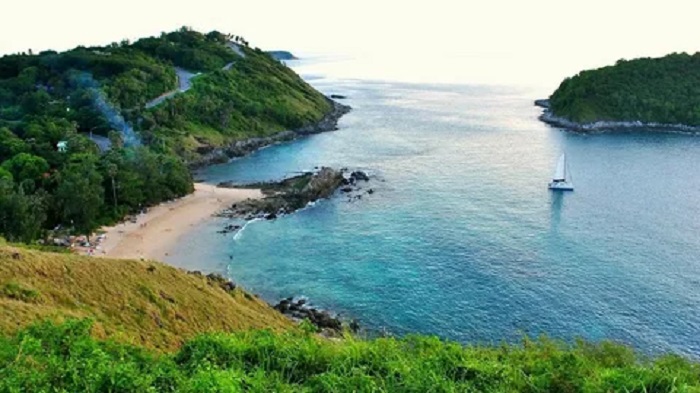
Phuket is easier to understand when its historic centre, temples, beaches and viewpoints are connected in one journey. A rental car allows travellers to explore beyond a single resort and adjust the schedule when traffic or weather changes. One of the island’s most rewarding routes begins in
Phuket Old Town, crosses the southern hills and finishes at Promthep Cape around sunset.
The complete loop, including the return to Phuket Town, covers roughly 55 to 65 kilometres. Actual driving time can exceed two hours because congestion often develops around Chalong Circle, Kata and the southern viewpoints. Plan a full day rather than attempting to fit the route between other
excursions.
Phuket Old Town and Wat Chalong
Start in Phuket Old Town before the streets become busy. The historic district covers Thalang Road, Dibuk Road, Phang Nga Road, Krabi Road, Yaowarat Road and Soi Romanee. Restored shophouses reflect the island’s tin-mining history and the influence of Chinese, European and Peranakan communities.
Park legally outside the busiest streets and continue on foot. The compact centre is better suited to walking between cafés, shrines, street art and heritage buildings than to searching for a space directly beside every attraction.
On Sundays, the Lard Yai walking street operates on Thalang Road from approximately 16:00 to 22:00. Road closures and increased pedestrian traffic make an early visit especially useful. Travellers who want to attend the market should return later without depending on central street parking.
From Old Town, drive approximately seven kilometres to Wat Chalong, also called Wat Chaitaram. It is Phuket’s best-known Buddhist temple and remains an active religious site. Wear clothing that covers shoulders and knees, speak quietly and remove shoes where signs request it.
The temple complex has parking, although the entrance can become congested when several coaches arrive together. Use marked spaces and avoid waiting beside the main gate.
Wat Chalong to Karon Viewpoint
Continue from Wat Chalong towards Highway 4233 and Karon Viewpoint. This elevated stop is also known as Three Bays Viewpoint because it overlooks Kata Noi, Kata Yai and Karon in a clear sequence of crescent-shaped bays.
The journey includes bends and gradients, but the road is paved. Drive at a speed that allows for motorcycles, vehicles entering side roads and sudden slowing near viewpoints. Phuket drives on the left, which deserves additional attention after every stop if the driver normally uses right-hand
traffic.
Parking at Karon Viewpoint is limited. If the marked area is full, do not stop on a bend or narrow the traffic lane. Continue to a safe place and return later if necessary. Around 15 to 20 minutes is usually enough to enjoy the view unless cloud or rain hides the coast.
For this route, a compact vehicle is generally easier to park and position than a large SUV. Travellers can compare suitable cars through RentGo Phuket before choosing their pickup location and travel dates.
Nai Harn, Ya Nui and Rawai
From Karon Viewpoint, continue south to Nai Harn Beach. The beach lies about 18 kilometres from Phuket Town and has a freshwater lagoon behind the coastal area. It is the most suitable stop on this itinerary for a longer break or swimming when conditions are safe.
The Phuket provincial tourism page advises against swimming at Nai Harn from May to October because currents may be strong. Conditions vary from day to day, so follow the flags displayed on the beach. A red flag means that entering the water is unsafe.
The road from Nai Harn climbs towards the Windmill Viewpoint area and passes Ya Nui, a small cove between the hills and Promthep Cape. Parking close to Ya Nui is limited. Do not leave the vehicle where it blocks local driveways or reduces visibility on a curve.
Continue approximately three kilometres to Rawai. The seafront is known for restaurants, accommodation and long-tail boats travelling to nearby islands. It makes a convenient lunch stop, while Nai Harn usually provides more space for a conventional beach break.
Check mirrors carefully before opening a door or moving away from the roadside. Motorcycles frequently pass between slow vehicles, particularly in populated sections of Rawai and Chalong.
Sunset at Promthep Cape
Promthep Cape occupies the southern end of Phuket and is one of the island’s most popular sunset locations. The provincial tourism authority places it approximately seven kilometres from Rawai Beach. Traffic becomes heavier as sunset approaches, especially during the dry season and on clear
weekends.
Aim to arrive 45 to 60 minutes before sunset. This allows time for the final approach, parking and the walk to the main viewpoint. Arriving at the exact sunset time often means watching the sky from a traffic queue rather than from the headland.
The upper viewing area provides wide views without requiring the steep walk down the cape. Visitors who continue along the lower path should wear stable footwear and return before darkness makes the uneven ground difficult to see.
After sunset, waiting 15 or 20 minutes can make the departure less stressful. Let the first coaches and tour vehicles leave before joining the traffic towards Rawai and Chalong. The return to Phuket Town normally completes a circuit of approximately 55 to 65 kilometres.
This route reveals several sides of Phuket in one day: heritage streets in Old Town, Buddhist culture at Wat Chalong, the layered coastline from Karon Viewpoint, beach scenery around Nai Harn and the open Andaman horizon at Promthep Cape. In 2026, Phuket remains one of Thailand’s most practical
islands to explore by car, particularly for travellers who value flexibility and want to see more than the area around their hotel.